Time-traveling To April 1968: Highlights From Motor Trend
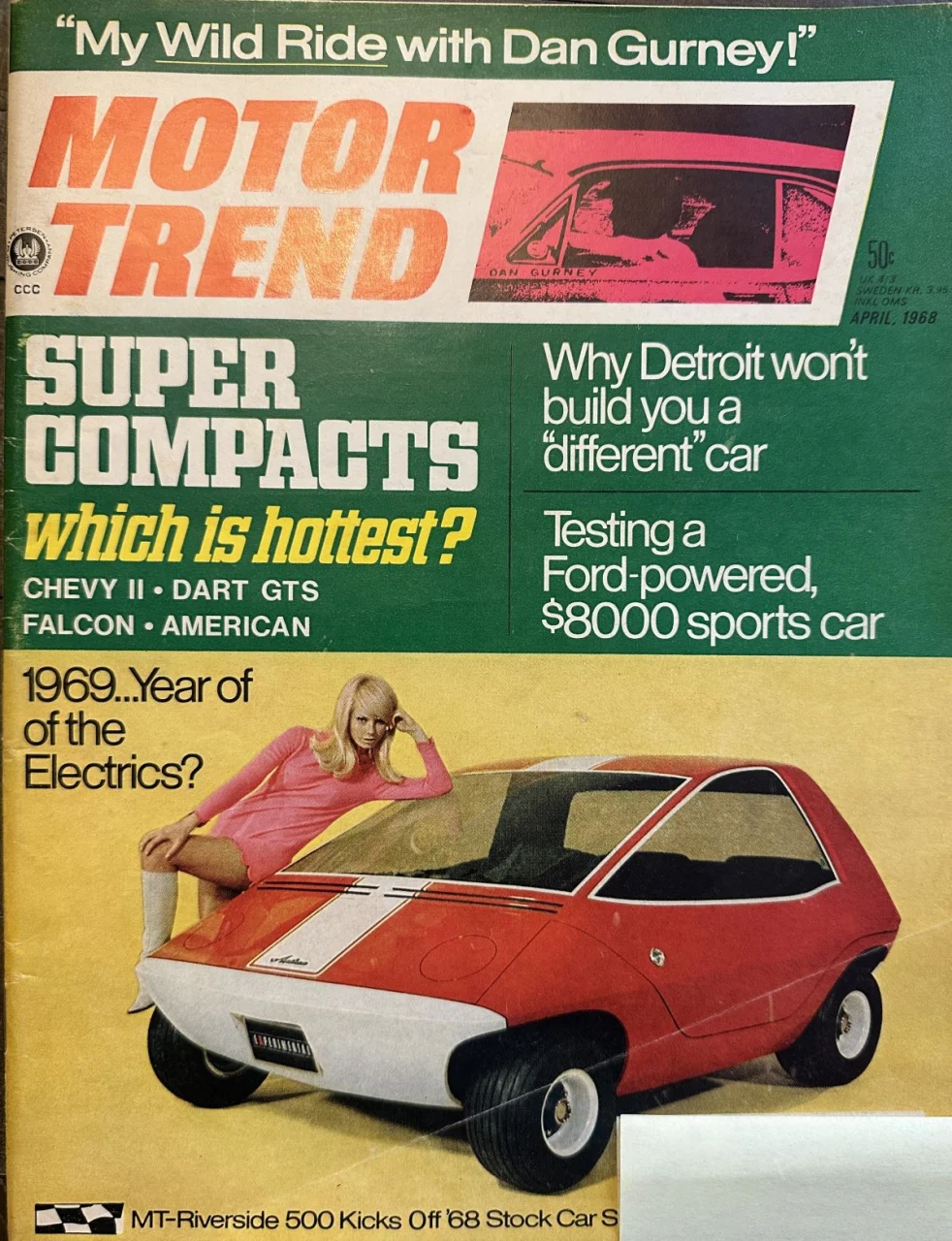
More power! The late 1960s marked a heyday for the muscle car era as domestic automakers continually one-upped each other by amplifying performance of their sports cars. High-displacement V8 motors and limited-slip rear ends were giving rise to a growing drag-racing scene.
Yet, in April 1968, Motor Trend magazine ran a photo on its cover of a quicky two-door electric car and surmised about 1969 becoming the “Year of the Electrics.” As it turns out, not many people paid attention to electric cars in 1969… or 1979… or 1989. In fact, even as of 2025, electric vehicle sales only account for about 10 percent of new cars sales according to a study by PricewaterhouseCoopers. But that doesn’t mean the EV market share isn’t growing, because it is. Sales in Q3 2025 grew by about a third year-over-year, so the momentum is there.
In the story about the “future” electric cars of 1969, Bob Fendell wrote, “The breakthrough to a quiet, smogless car is nearing. When it comes, your life on wheels will change.” He went on to say, “Service stations would merely add plug-in or quick recharge facilities impractical at home and would learn new repair skills.” As it turns out, Fendell was right about charging stations.
Quotable Lines
Thumbing further through the issue of Motor Trend, there were a few more interesting takeaways. Following were some quotes that stood out to me from the Inside Detroit section.
- “Anti-smog regulations proposed for 1970 by the federal government may be harder to meet than the industry expected.”
- “The California Planning and Conservation League, a lobbying group for conservationists, has recommended and will probably ask the 1968 California legislature to ban the sale of smog producing motor vehicles, with a deadline set for 1980.”
- “Chrysler made a running change in its 1968 intermediates to make the ash trays usable. Previously, the ash trays on the middle size Dodge and Plymouth cars were virtually useless, even for those 100mm cigarettes.”
- “The auto companies may wind up in trouble with the government again because of the way they are pushing high-performance cars for street racing.”
- “Officials of the New Jersey and Ohio highway departments say surveys have shown that red, yellow, or green colored pavement at intersections and freeway ramps can help daytime drivers make crucial decisions faster.”
- “First it was disappearing headlights, then concealed windshield wipers. The next to go out of sight may be your car’s antenna.”
Marketing Materials
The advertisements in old magazines are just as entertaining as the articles themselves. These were a few that caught my eye.
- AMC AMX: Limited to 10,000 units per year
- Pontiac GTO: Including pictures of GTO models from the four prior years
- Chevy II: Touting the 295hp 350ci V8
- Oldsmobile 4-4-2: With a 400ci “Rocket” V8
- “Awhile-a-Wipe” (interval windshield wipers) and Sequential Turn Signals from Tibbets Electronics. These innovations (priced at $12.95 and $19.95 respectively) were products designed to help buyers add features to their cars.
Win a Car!
Lastly, car giveaways were apparently a big thing in the 1960s. You might recall a story I wrote earlier this year about a “Super Sport Sweepstakes” promotion that took place at Chevrolet dealers around the nation. As it turns out, the Mohawk Rubber Company promoted its “GT500 Sweepstakes,” wherein a grand-prize winner could drive away in a Ford Mustang Shelby Cobra GT500.
Another example was a small advertisement previewing the giveaway of a 1968 Pontiac GTO. It would be great if we could track down the locations of those “prize cars” today. Also, I wish free cars were more of a thing in 2025. I guess there’s always Vegas, or The Price Is Right.
As Bob Fendel concluded in his story about electric cars, “Stick around… cars are becoming more exciting than ever.” Do you think that statement still holds true in modern day?
Popular Products
No popular products available in this category.