Jeff Boyd On Cops, Teachers, And Chicago
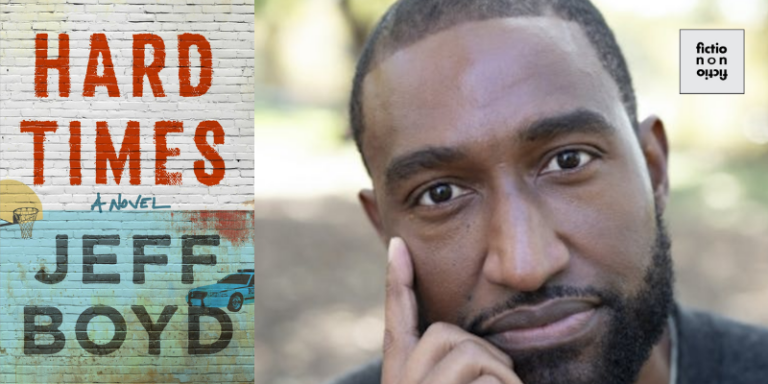
Novelist Jeff Boyd joins co-hosts V.V. Ganeshananthan and Whitney Terrell to talk about his new work of literary crime fiction, Hard Times, which is set in Chicago, where he lived previously. The hosts ask about the influence of police procedurals on the portrayal of the novel’s main character, a mixed-race cop named Curtis, and Boyd considers whether there is a gray area between “good cops” and “bad cops.” He also discusses the character of Curtis’s brother-in-law, a high school teacher named Buddy Mack, and reflects on how his own experience as a teacher informed his writing of Buddy as well as the portrayal of students. He explains how his own childhood as the son of a police officer gives him insight into that profession, and shares his experience of hearing feedback from his father. Boyd reads from Hard Times.
To hear the full episode, subscribe through iTunes, Google Play, Stitcher, Spotify, or your favorite podcast app (include the forward slashes when searching). You can also listen by streaming from the player below. Check out video versions of our interviews on the Fiction/Non/Fiction Instagram account, the Fiction/Non/Fiction YouTube Channel, and our show website: https://www.fnfpodcast.net/ This podcast is produced by V.V. Ganeshananthan and Whitney Terrell.
Others
Law & Order • The Wire • Chicago PD • Romeo & Juliet by William Shakespeare
EXCERPT FROM A CONVERSATION WITH JEFF BOYD
Whitney Terrell: So the book is called Hard Times, but I was thinking about the idea of hope as it exists for these characters whose futures are so uncertain. Zeke and Truth are dealing with violence, socioeconomic realities, and family pressures. We’re in a period of time when conversations about crime, police and inequality are very present in American politics, as we’ve been discussing already in this book. So what possibilities or limits did you want to explore for these characters in the novel?
Jeff Boyd: Well, I am someone who’s very tuned into what’s going on in the news. I wanted the realities of their life to be there. I think of myself as a realist. The characters’ ceilings can be as high as anyone’s, but the reality of it is that they have so many things in their way. The book’s called Hard Times because, yeah, they’re going through a tough time. Every character in this book is at a precipice of a change. As a writer, I kept telling myself that I was going to put them through the paces. Once I had my characters, I would try to put them in peril that I didn’t know how they were going to get out of it. Then I would try to find ways for them to get out of it. In the book, there’s a lot of times where what one character wants is going to complicate or make it impossible for the other person to get what they want. And then there’s just such things as some people are hungry. Zeke has a moment where he doesn’t know if he’s going to be able to get the EBT card that he needs to buy food. No matter what interpersonal problems they’re having, whether in school or on the football field, there’s still the simple matter of shelter and clothing and security, which is real. I’ve had students where I realized that there’s so many things that are going to get in the way of them actually being able to get to school and be ready to learn. I wanted to highlight those moments as well.
WT: Were there certain students that you were thinking of when you were writing these pictures, that you remembered from having them in class? Or are they composites? How did you go about that?
JB: I would say they’re composites. That was the nice part about it. My first book was the first person, maybe a little more autobiographical, whereas this book was really about finding characters that I could work with, like finding my cast. So a lot of the students are based on at least things I’ve known about other students. I can close my eyes and see each one of those characters, and I see them as real people, almost because I was able to Frankenstein them out of real situations that I’ve been in, real kids that I’ve worked with and known and cared about.
V.V. Ganeshananthan: Setting seems like it’s so important to your work. As you mentioned, The Weight is semi-autobiographical, and you were also writing about things that reference or depict experiences that you had with others. How did you think about this in terms of this novel? Did anyone who was in Chicago working with you beta read this for you? How did you think about writing about a place you had lived in recently, with people you had worked with, and with kids? Chicago looms so large in American mythology so to depict, as you note, the very real problems, you also run into issues of entrenched narratives or stereotypes. How did you think about making this fresh, and keeping yourself accountable to the world you were writing about?
JB: Fortunately, I don’t really like labels. I don’t like to be pigeonholed or stereotyped myself, or to do it to others. I’m always open to the person that’s in front of me, and that’s how I thought about these characters. I didn’t feel like I had to tell the whole story of Chicago; I had to tell the story of individuals in this book, and I had to tell it in a way that was genuine and real. That was my bar. Everything Truth is saying in this book, I asked “Is this accurate and real in a way that I can believe, or others would believe?” Same thing with Buddy and Curtis. I had some police people in my life; my dad was a cop, so I could have him read that. Being the father of young children and a police officer, I knew what that was, at least from him. I could ask stories “What was it like? Why did you become a cop?” He was like, “Well, I needed a job, you were on the way, and your brother was. I needed to have a steady job. This is what I could do.”
Similarly, I have a lot of relatives living in Chicago, including one of my brothers. I had him read an early draft and say, “Does this seem right?” He works with kids, so I was like, “These kids, like they sound right to you?” I also listen to a lot of Chicago hip hop and Drill, and that helps too. I just felt like, if I got the voices right, if I was true to the characters as I knew them, they didn’t have to worry about what the stereotype of someone else did. That’s someone else’s problem. I just wanted to get like these characters right, and if I did that, that was going to be proud.
And I didn’t want to highlight, just like, the negative things that people think or say about people in the south and west side of Chicago. I wanted to highlight also, like you said, that people have good times, people have families, structures that work for them, that there is joy. Not everyone’s just walking around looking glum. There’s good times to be had. And I wanted to highlight that as well.
Transcribed by Otter.ai. Condensed and edited by Rebecca Kilroy. Photograph of Jeff Boyd by Imani Waterfield.
Popular Products
-
 Enamel Heart Pendant Necklace
$49.56$24.78 -
 Digital Electronic Smart Door Lock wi...
$211.78$105.89 -
 Automotive CRP123X OBD2 Scanner Tool
$649.56$324.78 -
 Portable USB Rechargeable Hand Warmer...
$61.56$30.78 -
 Portable Car Jump Starter Booster - 2...
$425.56$212.78