Baby Boomers Should Answer These 3 Questions Before Locking In A Retirement Date
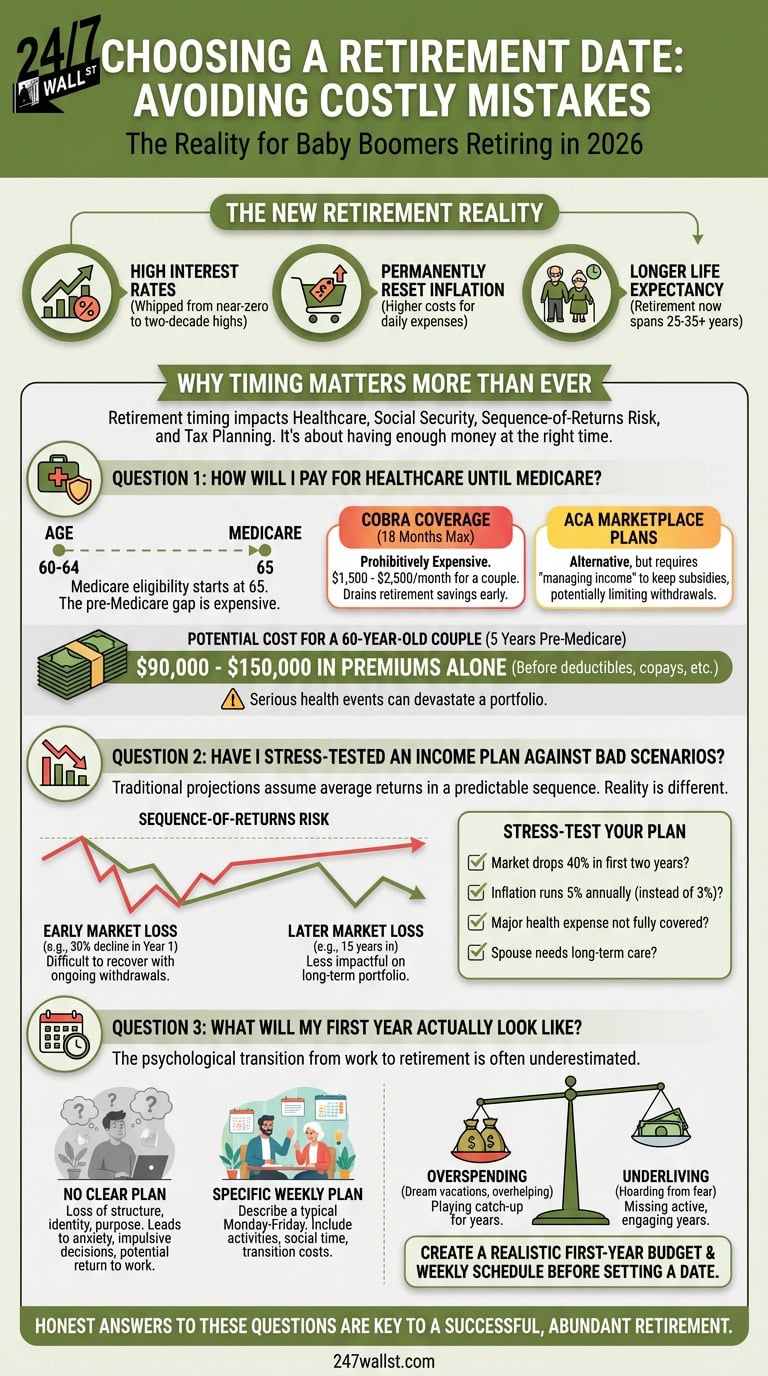
Choosing a retirement date feels like the finish line after decades of work, as you have saved diligently, watched your balance grow, and you are now ready to reclaim time in your life. However, you have to act smartly and recognize that the reality is that you can’t just arbitrarily pick a retirement date or pick one based on emotion, as this can lead to costly mistakes.
Quick Read
-
A 60-year-old couple retiring before Medicare could face $90,000 to $150,000 in healthcare premiums alone over five years.
-
A 30% market decline in the first year of retirement creates a nearly impossible hole to recover from due to ongoing withdrawals.
-
Retirees without clear plans for their time are more likely to return to work within the first two years of retirement.
- Are you ahead, or behind on retirement? SmartAsset's free tool can match you with a financial advisor in minutes to help you answer that today. Each advisor has been carefully vetted, and must act in your best interests. Don't waste another minute; learn more here.(Sponsor)
Baby boomers who are retiring in 2026 are unfortunately facing a unique set of circumstances. They have watched as interest rates have whipped from near-zero to the highest levels in two decades, and they have seen inflation permanently reset pricing levels for just about everything they spend money on regularly.
More importantly, and perhaps most importantly of all, baby boomers are living longer than ever, and financial planning now needs to cover around 25, 30, and even 35 years of living without working. This means what is going to separate successful retirements from stressful ones is going to come down to preparation before giving notice at work. The following three questions deserve honest answers before committing to a date, and the answers might push a retirement date forward or back.
Why the Timing Decision Matters More Than Ever
Retirement timing isn’t just about having enough money, it’s about having enough money at the right time, in the right accounts, with the right protections in place. Someone retiring at 62 faces a different set of financial challenges than a boomer retiring at 70. Healthcare coverage, Social Security optimization, sequence-of-returns risk, and tax planning all shift based on when you pull the trigger. Getting the timing right, or even close to right, can mean the difference between a retirement that feels abundant and one that feels perpetually constrained.
Question 1: How Will I Pay for Healthcare Until Medicare?
Medicare eligibility starts at 65, but many boomers not only want to retire earlier, but are hoping to do so, and any gap, even if it’s just one year or five, represents one of the most expensive and underestimated challenges in retirement planning. It’s well worth remembering that employer health insurance disappears the day you leave, and replacing it isn’t simple or cheap.
COBRA coverage might allow you to continue on an employer’s plan for up to 18 months, but this is prohibitively expensive. You are likely going to pay a full premium plus a 2% admin fee, which likely means around $1,500 to $2,500 per month for a couple, and this money comes right out of retirement savings during critical early years. ACA marketplace plans offer an alternative, but carefully “managing income” in retirement often means keeping withdrawals artificially low, which creates its own complications.
The bottom line is that medical expense numbers can get uncomfortable quickly, as a 60-year-old couple with five years until Medicare could face $90,000 to $150,000 in healthcare premiums alone before any coverage kicks in. Of course, this number is before any deductible, copays, and out-of-pocket maximums. Any kind of serious health event during this non-Medicare period could lead to a massive impact on a retirement portfolio, so before locking in any pre-65 retirement date, boomers need a specific and budgeted healthcare plan in place.
Question 2: Have I Stress-Tested an Income Plan Against Bad Scenarios?
Most retirement projects show a steady line as you withdraw a certain percentage annually, your investments grow at an assumed rate, and the money lasts. These projections are useful for general planning but dangerous as actual guides because they assume average returns arriving in a predictable sequence, but reality doesn’t work this way.
Sequence-of-returns risk, the danger that poor market performance early in retirement can permanently damage your portfolio, is something of a silent killer of baby boomer retirement plans. A retiree who experiences a 30% market decline in the first year of retirement faces a very different financial trajectory than someone who experiences a similar decline 15 years into retirement. This is true even if average returns over the full period are identical. The early loss, combined with ongoing withdrawals, creates a hole that is nearly impossible to climb out of.
Stress-testing means running your plan through genuinely bad scenarios, such as “What if the market drops 40% in your first two years? What if inflation runs 5% annually instead of 3%? What if you face a major health expense that insurance doesn’t fully cover? What if your spouse needs long-term care?” A retirement date that works in optimistic scenarios but fails when stress tested isn’t actually a viable retirement date.
Question 3: What Will My First Year Actually Look like?
The psychological transition from work to retirement catches many Boomers off guard. After decades of structure, deadlines, colleagues, and a purpose that is tied to a professional identity, the sudden absence of all four can trigger anxiety, depression, and impulsive decisions. Studies have shown that retirees without clear plans for their time are more likely to return to work within the first two years of retirement.
However, this question isn’t solely psychological, as the first year of retirement sets behavioral patterns that are likely to persist. Retirees who overspend in their first year of retirement, like taking a dream vacation or overhelping the grandkids, often find themselves playing catch-up in the next few years. Those who underlive, or hoard money out of fear, could miss some of the best and most active and engaging years of retirement, so it’s a balance.
Before setting a date, you must be able to describe a typical week in your first retirement year with specificity. Vague ideas like “traveling more” or “spending time with family” are nice, but actual plans, like what you are going to do Monday through Friday, who you will spend time with, will help you create a realistic first-year budget that accounts for transition costs and lifestyle adjustments without going overboard.
If You have $500,000 Saved, Retirement Could Be Closer Than You Think (sponsor)
Retirement can be daunting, but it doesn’t need to be. Imagine having an expert in your corner to help you with your financial goals. Someone to help you determine if you’re ahead, behind, or right on track. With SmartAsset, that’s not just a dream—it’s reality. This free tool connects you with pre-screened financial advisors who work in your best interests. It’s quick, it’s easy, so take the leap today and start planning smarter! Don’t waste another minute; get started right here and help your retirement dreams become a retirement reality. (sponsor)
The post Baby Boomers Should Answer These 3 Questions Before Locking In a Retirement Date appeared first on 24/7 Wall St..
Popular Products
-
 All-Purpose First Aid Kit for Home & ...
$144.99$100.78 -
 CPR Breathing Mask with One-Way Valve
$33.99$22.78 -
 Lightweight Waterproof Outdoor Surviv...
$111.99$77.78 -
 Smart Ring Health Tracker
$67.99$46.78 -
 Unisex Arch Support Shoe Pads
$48.99$33.78