Disability: Income, Unemployment, & Education
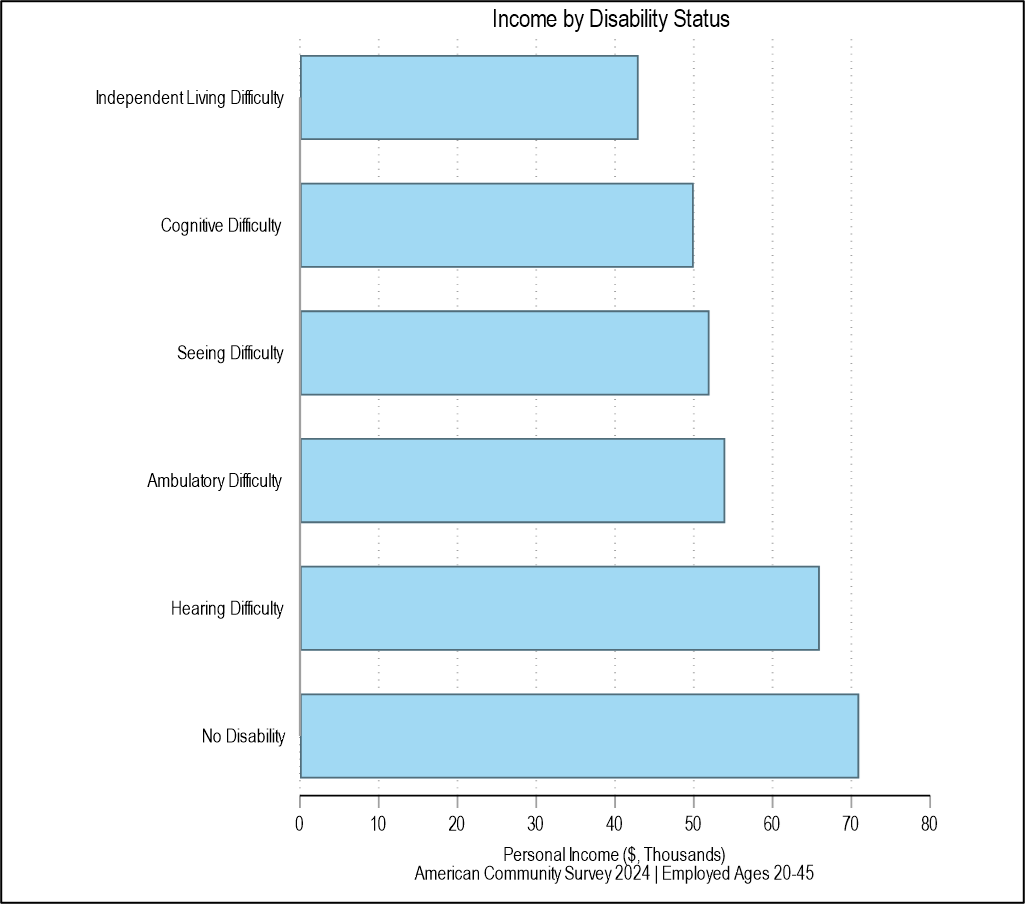
Let’s talk about disability. The American Community Survey (ACS) identifies seven broad categories, not including the baseline case of ‘No Disability’. I’ve written before about how disability designations are difficult because many qualifying conditions are a matter of degree. Surely you’ve met a person who is legally blind but can see *some*. How much sight ability can remain while still being considered blind? If a person can identify the sun’s location, but nothing else, then is that person still blind? Similarly, who’s to say whether some physical or cognitive characteristic is disabling? Why not enabling – depending on the task?
Wisely, the ACS side-steps this entire discussion and simply asks respondents whether they have “difficulty”. We can be agnostic about the cause and degree while still trying to get at the heart of the matter. One downside is that people tend to have more difficulty as they age. Since that’s not relevant for earlier life economic outcomes, I only examine ages 24-45. Difficulty with “self care” is too small of a category in the 2024 ACS for the analysis here. Below are the other six difficulties identified: