Balance, Flow, And Core Strength
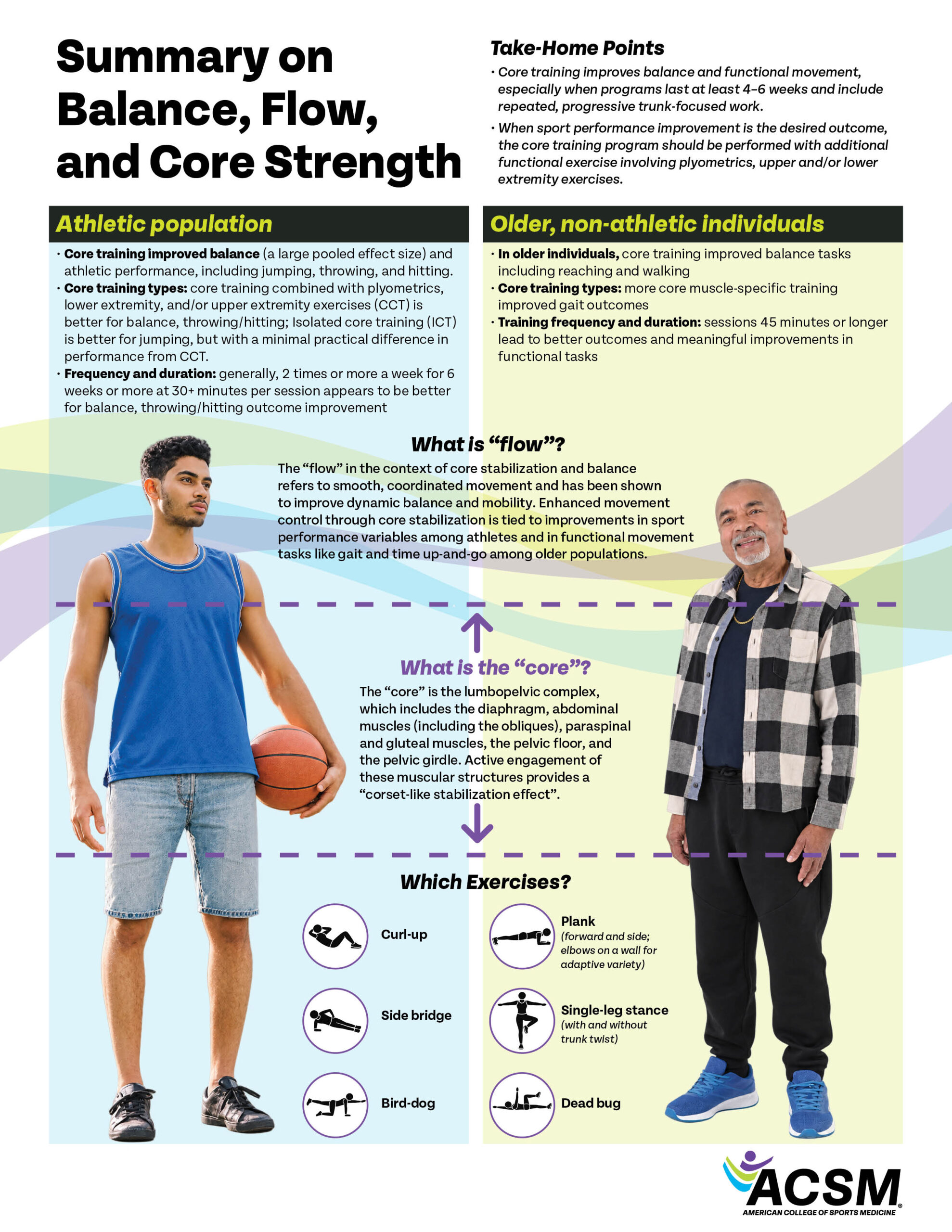
Core training supports balance, smooth movement, and functional performance. This post explores how core stabilization works, what research shows in athletes and older adults, and exercises used to develop core strength.
Click infographic to download PDF. What is the “core”? The “core” is another name for the lumbopelvic complex, with its muscular boundaries including the diaphragm, abdominal muscles (including the obliques), paraspinal and gluteal muscles, the pelvic floor, and the pelvic girdle. Active engagement of these muscular structures provides a “corset-like stabilization effect.” This core stabilization relies on pre-programmed, well-coordinated integration of multiple body functions, including the passive, active, and neural subsystems of the muscular structures in the “core” region. Core stabilization provides proximal stability, which leads to distal mobility and effective intersegmental force generation and transfer, contributing to performance enhancement and injury prevention (Kibler et al., 2006; Bliven et al., 2013).