The Pitfalls That Derail Home Health Providers’ New Palliative Care Efforts
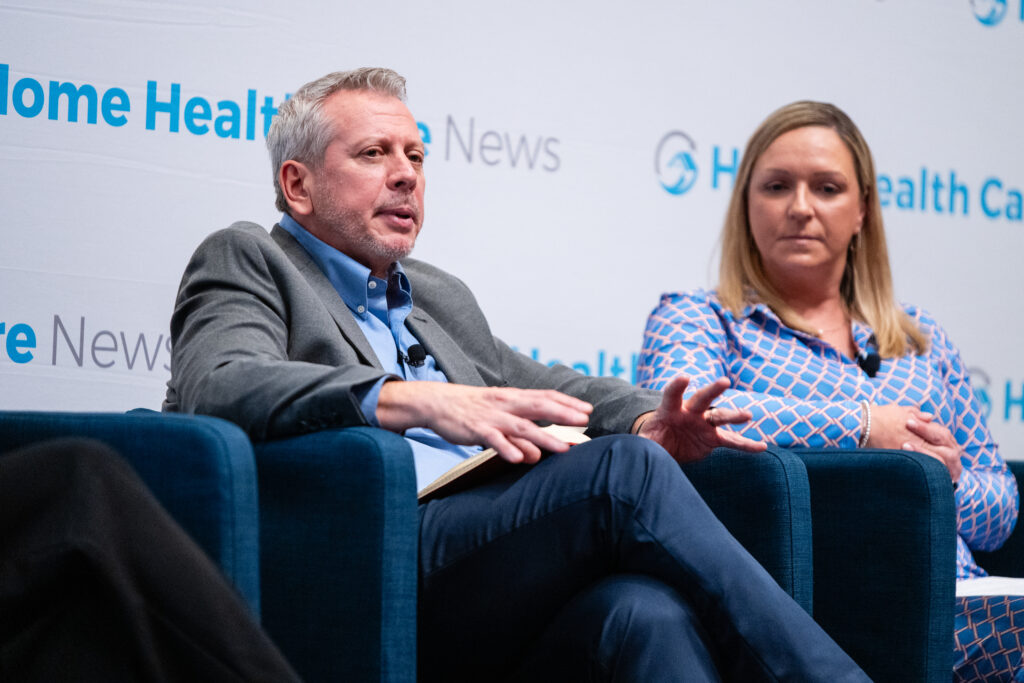
For home health companies, embracing palliative care can elevate overall service offerings. However, providers are sometimes stopped in their tracks before establishing a program that can help improve outcomes for patients.
Though home health-operated palliative care is a rarity, companies like Visiting Nurse Health System, Contessa Health and Compassus have managed to successfully incorporate these services into their broader care delivery model.
When structuring an effective palliative care services program, there are some common pitfalls home health providers should avoid.
“One of the biggest ones is positioning palliative care as early hospice,” Nikki Davis, senior vice president of palliative care programs at Contessa, said at Home Health Care News’ FUTURE conference. “And just make sure that there’s also clear eligibility and referral pathways, so that when you’re partnering with your home health and hospice teams, you have those processes in place, so that it’s very clear who’s eligible for palliative care.”
Contessa provides comprehensive in-home care. The company is based in Nashville, Tennessee, and partners with 12 health systems and 30 health plans. Amedisys Inc. (Nasdaq: AMED) acquired Contessa in 2021.
Dr. Kurt Merkelz, Nikki DavisAmedisys has a palliative care program under Medicare Part B, and Contessa also offers value-based palliative care programs.
“Within the Contessa value-based space, we have a couple of different financial contracts and different levers that we pull for those mechanics,” Nikki Davis said. “One unique one is with our joint ventures, where we actually partner with healthcare systems and deliver different types of home-based services, hospital-at-home, SNF-at-home and palliative care at home. Then we also have direct-to-payer contracts, where we partner directly with the insurer to help care for their members who need palliative care in the home.”
The provider also has a full risk contract with a payer. Nikki Davis noted that the company plans on observing and determining which approach warrants further investment for future growth.
Dr. Kurt Merkelz, chief medical director at Compassus, outlined a number of ways home health providers can be derailed from running an effective palliative care program.
“Not truly investing in the value that palliative care brings, so not offering a comprehensive, interdisciplinary, complete package of palliative medicine,” he said. “That is one of the biggest obstacles and barriers that result from not adequately planning and strategizing what your palliative care component could be. Next would be a structure that overly focuses on either just an RN, just an LPN model. True palliative care is a real interdisciplinary approach. It requires the full spectrum of support services to really achieve the necessary patient outcomes.”
Based in Brentwood, Tennessee, Compassus provides a wide range of home-based care services, including home health care, home infusion, palliative care, hospice care and home-based high-acuity care. It has more than 270 touchpoints across 30 states. Compassus’ palliative care program operates through joint ventures. The provider recently expanded its joint venture with Providence Health System, focusing on strengthening home-based care services.
Collapsing silos, coordinating care
Another error that home health providers often make when implementing a palliative care program is creating unnecessary silos.
“I would think about clinical integration with your home health agency,” Merkelz said. “You can’t keep the palliative care service line as a siloed structure, then you’re continuing to propagate what we see so often in the sector with fragmented health care.”
Failing to understand the demands of a palliative care program can also be damaging to its success, according to Merkelz.
“Starting too small and not recognizing how quickly a palliative care referral system can overwhelm the system, and then can lead to potential service failures and staffing issues,” he said. “Getting clinicians credentialed through the process and having enough [staff] to provide the care takes months to get onboarding, to get physicians credentialed through the various insurance agencies.”
Dorothy DavisDorothy Davis, president and CEO of Visiting Nurse Health System, emphasized the importance of engaging the company’s home health staff in order to improve their understanding of palliative care.
“That is no different to me than recognizing when someone is appropriate for hospice, more appropriate for hospice than home health,” she said. “What’s the right setting at the right time that brings the best and most value to a patient and to a caregiver? I think our workforce in general, and I say ours in a collective industry perspective, doesn’t have a lot of great education.”
Atlanta-based Visiting Nurse Health System provides a variety of home-based care services to over 7,000 patients across Atlanta. Its palliative care program has been around for 15 years. The company’s current model operates under Medicare Part B.
Ultimately, Dorothy Davis believes that coordinated care is a key element in effectively running a palliative care program.
“Transactional care does not change lives in the same way that coordinated care does,” she said. That’s the lens we bring to palliative care at Visiting Nurse Health System — recognizing you need good processes, you need good entry points.”
The post The Pitfalls That Derail Home Health Providers’ New Palliative Care Efforts appeared first on Home Health Care News.
Popular Products
-
 5X Magnifying Glass Lamp
$197.99$137.78 -
 Beauty Wand Red-Light Therapy LED Eye...
$45.99$32.78 -
 Elderly Portable Wheelchair and Toile...
$901.99$630.78 -
 Electric Lifting Bed Backrest
$507.99$299.78 -
 Anti-Slip Aluminum Mobility Aid Tool
$188.99$63.78