Fewer Medicare Advantage Plans Offer In-home Supports
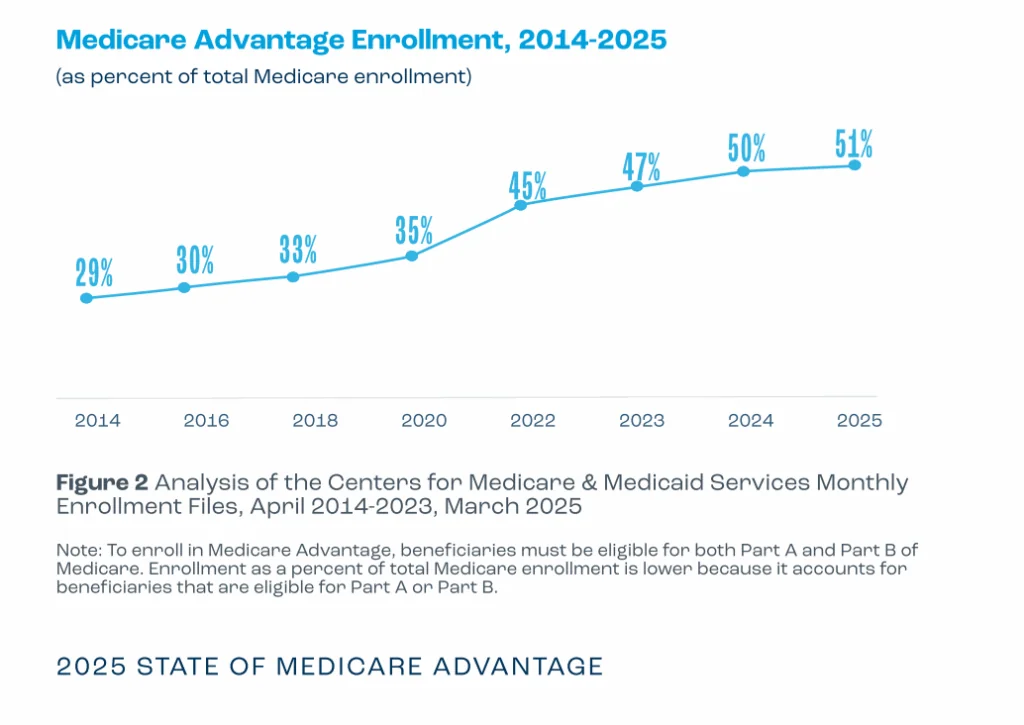
Despite increasing Medicare Advantage (MA) enrollment growth, the plans offering in-home support services decreased between 2024 and 2025.
That was one key takeaway from a recent report from Better Medicare Alliance. The report, which offers an overview of MA, including demographics, enrollment, benefits, cost savings and outcomes, touted high rates of satisfaction and cost savings – while noting that the number of plans offering in-home support services has dipped.
Better Medicare Alliance is a research and advocacy organization that supports Medicare Advantage.
Overall, 35.1 million people, over half of the entire Medicare-eligible population, are enrolled in MA, according to the report. MA plan enrollment has doubled in the last decade.
The amount of MA plans offered also saw a major increase, more than doubling, over the past decade. In total, 3,719 MA plans were offered in 2025.
MA enrollment is projected to continue increasing on to 2033, according to Better Medicare Alliance data.
In terms of demographics, Black and Latino people had higher rates of enrollment in MA plans compared to traditional Medicare. In total, 31.2% of MA enrollees are Black, Latino or Asian.
The report also found that 52% of MA enrollees are living 200% below the poverty line, compared to 32% of Medicare beneficiaries.
Additionally, dual eligible beneficiaries, people who qualify for both Medicare and Medicaid, were enrolled in MA at higher rates. More than 60% of the dual eligible population picked MA, compared to 50% of non-dual eligible beneficiaries.
Typically, MA plans include a number of supplemental benefits, this can include various home-based care services.
“Supplemental benefits are critical in Medicare Advantage’s approach to addressing social needs in the community and reducing health disparities among beneficiaries and within the broader health care system,” Better Medicare Alliance wrote in the report.
Though the report found that 99% of MA plans offered at least one supplemental benefit, home-based care as an offering became less common. Specifically, MA plans offering in-home support services dipped from 9% to 6% between 2024 and 2025.
The number of MA plans offering supports for caregivers, however, remained secure at 5%.
What more, offerings that allow seniors to live at home independently, such as bathroom safety devices went up from 22% to 24%.
While the Better Medicare Alliance’s report calls MA the “affordable, high-quality health care choice,” home health experts say its slim reimbursement rates and growing penetration are contributing to an industry “crisis,” with nonprofit providers being especially vulnerable to MA pressures.
While MA penetration has skyrocketed, home health utilization among its members has decreased as much as 63.1% over five years.
Industry insiders report that the 38% reimbursement rate difference between traditional Medicare and Medicare Advantage is home health providers’ most pressing challenge.
The post Fewer Medicare Advantage Plans Offer In-Home Supports appeared first on Home Health Care News.
Popular Products
-
 Adjustable Cosmetic Denture Set
$48.99$33.78 -
 Unisex Adjustable Back Posture Corrector
$71.56$35.78 -
 Hydra Exfoliation, Extraction, and Re...
$3,218.99$1926.78 -
 Neoprene Swim Fin Socks for Diving & ...
$28.99$19.78 -
 3D Compression Ankle Support Strap fo...
$15.99$10.78