Case Study: Improving Home Office Experience
source: freepik
Hey, Thanks for landing here, wish you an interesting & informative read!
This is a “Design Thinking” based case study. To enhance the Home Office experience of target users, before we hop into how I did it, let's have a glimpse of what exactly Design Thinking is.
What is Design Thinking
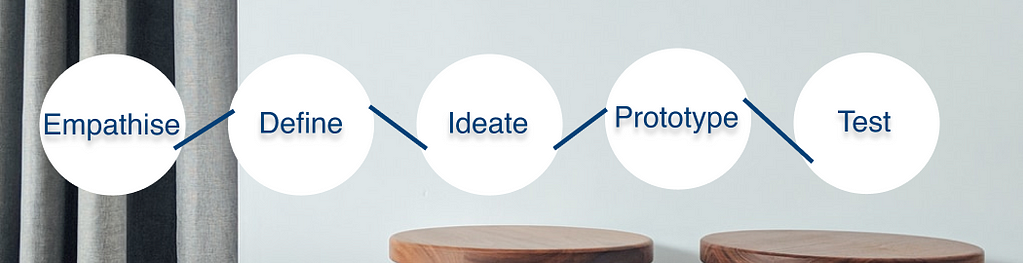
Hmm, sounds like some fancy word, right? well, the beauty of this word lies in the 5 steps that are collectively called design thinking process.
 source: created on Figma
Did you notice the image above? all those 5 steps are part of “Design Thinking Process” and when a designer solves a problem in these steps, then he is said to have worked using design thinking process. Let’s see what do we do in these stages.
Empathise —Here we try to know the people we’re designing for to understand their needs better.
Define — Here we define a problem statement and our target users.
Ideate — Here we come up with all different solutions we can think of.
Prototype — Here we create a rough but understandable visual of the solution we have decided.
Test — Here we show our solution(s) to users, get feedback and do improvements wherever it is required and possible.
If all that still sounded bookish just remember the steps, reading this case study further will make it more clear.
Show time (Ta-da!)
Before starting with any of the steps don't forget that “You are not User”, try to understand what your users are saying and never give or take solution right away, very first and only thing to do is, understand the problem before jumping on to the solution Period
Set a meeting — understand your users
Remembering “You ≠ User” I started with “Empathise” stage. I created a set of questions for my users, have a look at those…
Every interview started with the basic introduction of user, followed by these questions:
1. Do you have a dedicated home office space?
— If not where do you work?
— If yes, what is it like and how much do you like it?
2. Do you face any problem while working from home that you never noticed in the office?
3. Is your house spacious?
4. How many people are working in your family, where do they work (which part of the house)?
5. What is it about your home office that you like the most?
6. What is it that you do not like or wish it to be better?
7. Any feature in their mind they wish to include in their home office.
8. What do they do when they take a small break?
9. Do they interact with this area for anything other than work?
10. What would you pick to have around, among nature & technology and why?
 Source: created on Figma
I was done coming up with relatable questions, so I setup one on one interview with each of my user, below are some details about my users from the interviews.
we should always try to put ourself in user’s shoes, don’t be impatient if user is not able to put their problems clearly, no users knows what problems they have, we have to make conversation going untill we have enough input from the user.
Simaant Bhushan : Simaant is 26 years old IT Recruiter who lives in a joint family where everyone has their own spacious room. He likes bike rides, likes to sketch & cook. Simaant doesn’t have a dedicated home office, he does have a study table but he prefers working mostly on bed which he also uses to sleep. Simaant would like nature as well as technology around his workspace.
Like(s):
Likes the comfort of his bed.
Dislike(s):
Noise disturbance.
Poor internet connectivity.
Less sockets near the working area.
Shanvel : Shan has recently completed his graduation in Architecture, his family has 4 members including his parents and grandmother. He likes to play badminton and has recently learned guitar. Shan is currently not working anywhere. He doesn’t have a dedicated home office, for study he uses the storage room’s extra space and will be using the same for work in future. Shanvel would like nature around his workspace because he feels good connecting with nature .
Like(s):
The natural light in the room that comes through the window .
Dislike(s):
The table is not adjustable in height and angle.
Aditya Raj : Aditya is a final year B.tech Cs. student, he likes Martial art and listening to music. He did an internship in Business Analyst where he discovered his interest in the field of UX/UI. Aditya has a office setup that has a chair and table, where he keeps his laptop, some books and a small table. He uses it for work or study. Aditya likes nature around his workspace as it helps him with ventilation.
Like(s):
Solid chair, it helps with his back pain.
Dislike(s):
Height of his table.
Size of the table.
Abhishek : Abhishek is an IT student, he is currently preparing for frontend development, he likes Cooking. Abhishek has a work setup in his bedroom that has a chair & table, he has a music system that he keeps on top of the table apart from that there are so many other things that he sometimes needs to keep on the table while he is working (like : notebook, bottle etc.). He uses this space while studying also. Abhishek likes to be close to nature as well as to technology.
Like(s):
Likes that it is in his bedroom, where no one comes and he feels no distraction by any noise.
Dislike(s):
That workspace is near his bed because of which he often feels like taking a break to rest.
Lots of Wiring makes the space look messy.
What is my target?
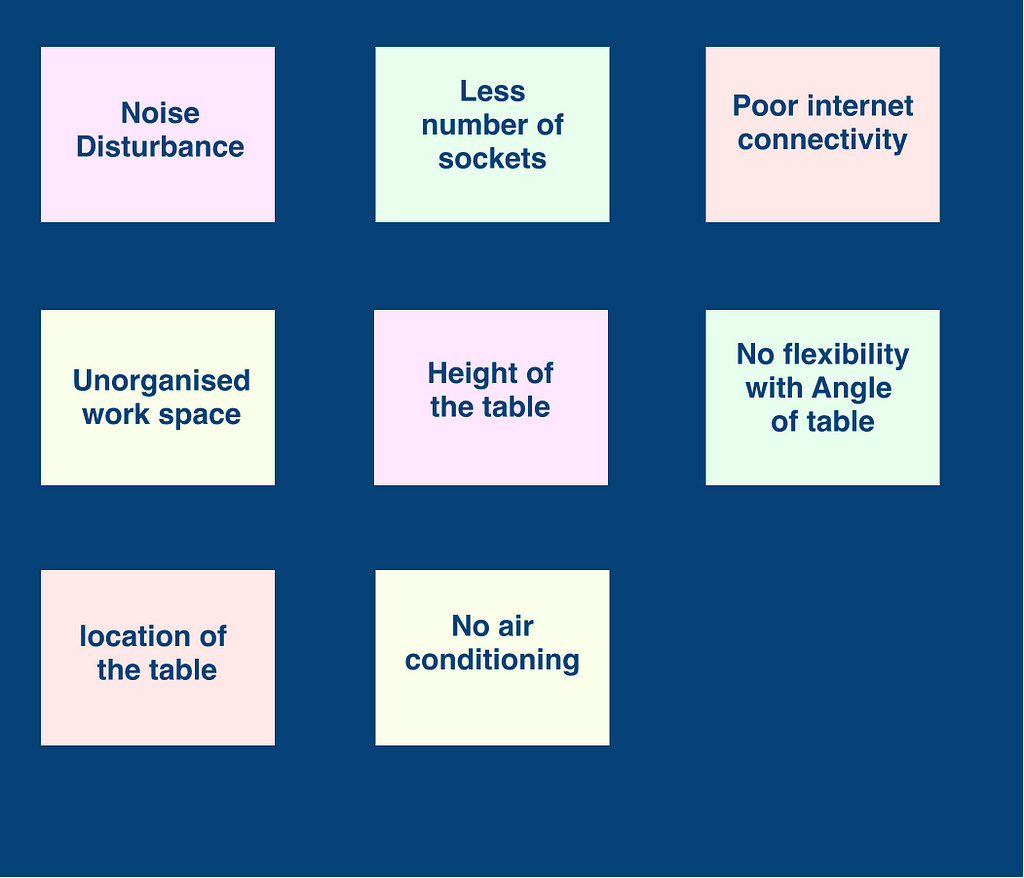
Once I was done with all the interviews, I reflected on my notes from the conversations and wrote down all the problem areas, this is what we call “Define” stage.
below are the problems that I have identified.
 Source : created on Figma
These problem were important to users.
keep reading to understand who had these problems, why it is a problem for them & when do they feel it is a problem:
Simaant and Abhishek feel —
Noise problem while working at their space, this is an important issue because when they have to attend calls/meetings they feel uncomfortable also it distracts them from concentrating on their work.
Less sockets near their workspace, it is important because they have to move to other locations which consumes time.
Because of less sockets they use extensions which makes the place look messy & doesn’t give a great environment experience and can be distracting at times.
Shanvel, Aditya and Abhishek feel —
Problem with Size of the table that they use for work. It is important to them because a table of smaller size doesn’t give them flexibility to keep more things on the table if they want to (ex: books, bottle, music system, notebooks, phone, a tablet maybe, keyboard, mouse, a pc, maybe snacks etc.).
Abhishek feel —
Problem with the height of the table that he uses for work. It is important for him because a table of smaller height gives him back pain, sometimes he uses an extra table to make the laptop/computer reach his eye level which he feels like takes most of the space on the table.
Problem with the location of the table, since its near his bed he often feels like taking a break .
Shanvel feel —
Problem with the angle adjustability of the table that he uses for work. It is important to him because he had a table at college with such option and he misses his experience and flexibility with the angle.
Wishes for an air conditioning system near his work area.
Simaant feel —
Problem with poor internet connectivity that he uses for work. It is important to him because poor internet connection add disruption in his work and important meetings.
Now, Ideate
In “Ideate” stage we come up with all the possible solutions we can think of, for all the problems we have identified and then we decide any one for our problem statement (we can also combine our ideas if we need to).
Ideas —
Sound proof room.
Noise cancelling headset.
Discussion with family to maintain a noise free environment.
Opt for places that provide work space with a great work environment.
Meditation technique, lessons for more concentration power.
More sockets near workspace.
Wireless extensions.
More organised extension.
Wireless charging spot.
Extra batteries or other power source.
Larger table.
More storage on table, maybe drawers or something.
Extra space near the table.
A separate table to keep things.
A cupboard on top wall/side wall.
Table with suitable height for user.
Table with adjustable height.
A table with a stand to match on top.
A chair of suitable height.
A chair of adjustable height.
Angle adjustability control.
A router with faster speed.
A wifi dongle.
AC.
More windows for ventilation.
These are instant ideas that I could come up with, for all the problems I identified earlier, these doesn’t have to be perfect .
 Source : freepik image edited on Figma
I ranked my ideas.
My top three ideas are:
1)Noise cancelling headset that has pre-downloaded nature sound(white noise) which helps in concentration.
Reason : Noise disturbance is something I feel is one of the very important problem that alters the user’s experience while working or doing anything that requires concentration.
I picked this idea as this doesn’t require construction of a sound proof cabin or anything as such, other family members entering their room, noises from neighbourhood and people talking serves as disturbance.
Having a noise cancelling headset will help them avoid noises and they can also switch to pre-downloaded white noise that will help them with concentration.
2)Providing a height and angle adjustable table for a much better ergonomic experience.
Reason : Many users face issues with the height of their table or the restriction of not being able to adjust the angle.
This idea would provide them control on the height and angle, working for hours with bad ergonomic experience is not good for heath in long terms and this solution can provide a good table experience.
3)Providing a separate easily movable storage, to help make their space look more organised with easy accessibility for required things.
Reason : Many users face space issues on the table, since they use the table not just for works but also to study, for meetings etc., there are things they like to have nearby their work area but because of space restriction they avoid or end up making the space unorganised by keeping so many things.
I feel this solution is good because many people already have a table that they would not want to replace, many others work on their bed.
so by providing a separate storage I am not asking them to replace what they already have invested in, or to use a table instead of bed, or have a dedicated workspace if they don’t.
but I am only providing them extra space to keep everything they might want to, near their working area in much organised manner.
I decided to go with 3rd idea from above.
Show your solution
how?… You create a rough visual of the solution you have come up with and tell them this is “Prototype”. I started with some rough sketch on a paper then try to create it on Figma (for more clear understanding).
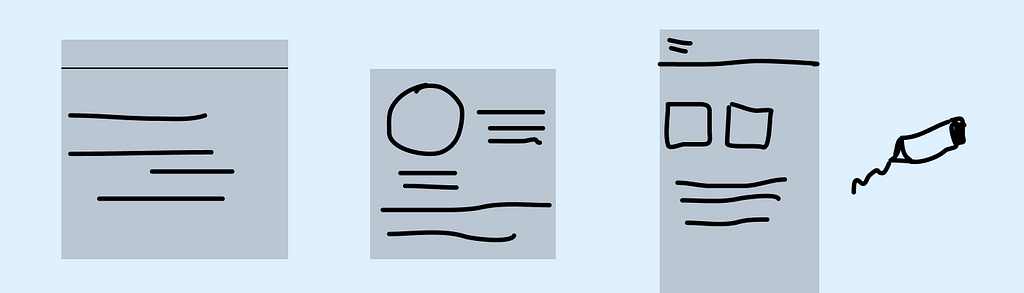 Source : created on Figma
I opt to provide users with something that can make their workspace look more organised and clutter free so they can work more calmly without getting distracted by the mess or wasting time to get something they need while working.
Some of my users had a table and chair, some preferred working on their bed or sometimes on the floor or any other space of the house they find peaceful.
They often find their work area/table has less space to keep everything that they need while working,
Some of them also feel having more sockets nearby would allow them to not move from time to time to places, to charge their devices.
I came up with a storage idea. with this idea I want to give my users a more space to keep things and an organise work space that would save their time.
 Source : 2D prototype created on Figma
I designed drawers for storage. On top of the storage I provided sockets & a wireless plate for wirelessly charging devices.
I did this because wireless charging would look more organised but then I also considered those devices that might not support wireless charging and provided 2 socket restricting the user from using more wired equipment on the space as it would not give the place an organised aesthetic look (which was the main goal here, to make the place look tidy & hassle free).
I am willing to improve
Since you designed for them you must ask them what they think about your solution. I went back to my users for “Testing” stage.
 Source : freepik image edited on Figma
Feedbacks
1.Placement of bottle holder near socket can cause electrical accidents if anyone spills water.
2.Power source. Here the user’s concern was what if they doesn’t have any socket nearby how will they be able to get power supply.
3.Shelf on storage instead of two drawers, one of my user said sometimes they need to keep things on top to grab quickly when needed.
4.one of the users felt Socket placement on top is sometimes problematic, it is better to have socket on side or back.
What now?
After going through the feedbacks, I started my brain storming , I needed to find a solution for the placement of bottle holder. I didn’t wanted it to be somewhere away from users sight.
with that I started a new prototype but this one felt like I am restricting the user to use this storage only on one side for a better experience, because I placed the bottle holder on right side and then it was same problem on having it on the left. Center also didn’t looked like a good option.
so I put further thoughts and here’s what I have come up with:
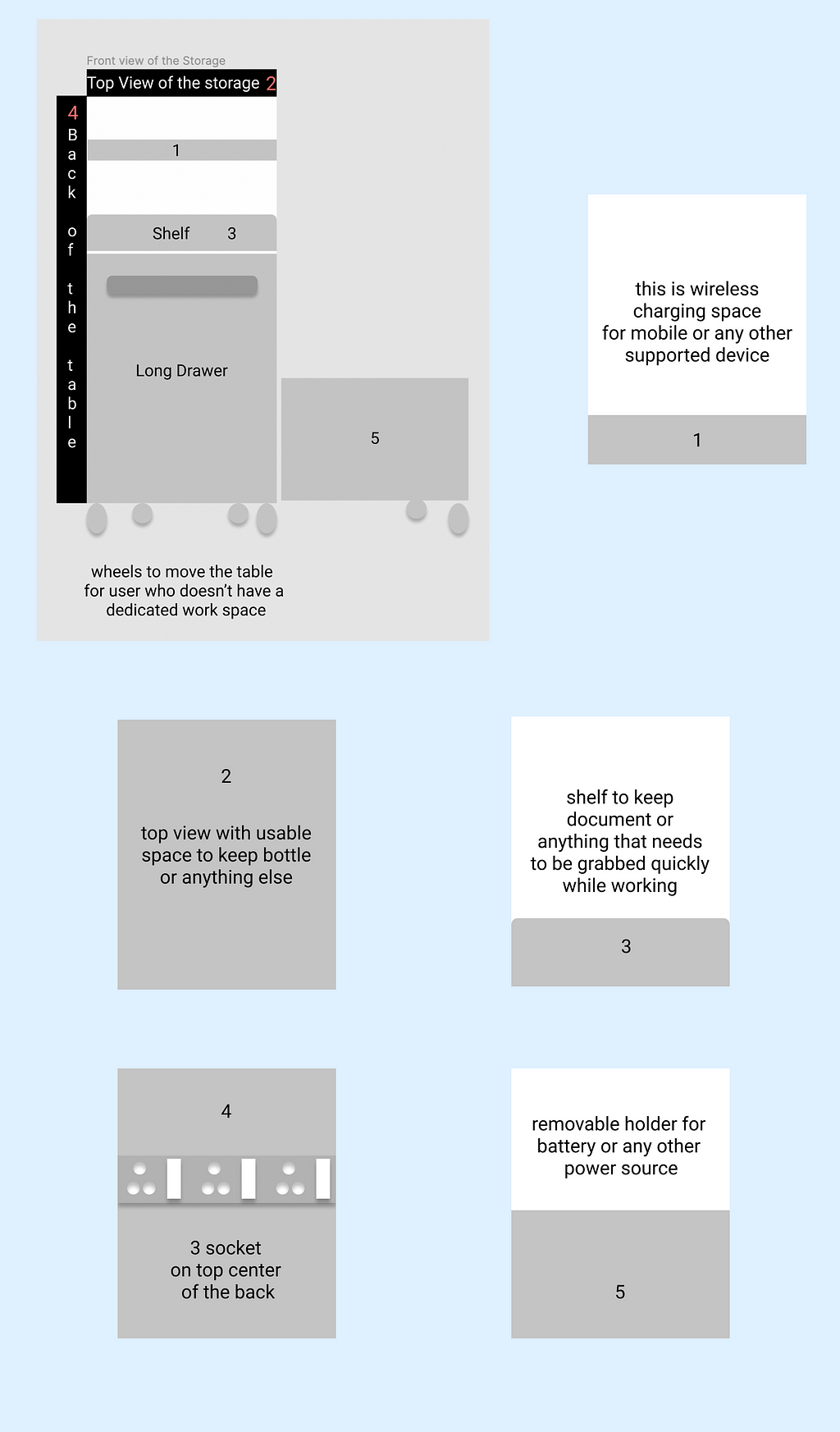
I completely removed the holder, sockets and wireless plate from the top,
Now users can simply keep their bottle on top. I provided a holder earlier to give an extra grip to the bottle because there were sockets and charging plate nearby.
Removing the holder and charging options from top would also give users space to keep other stuff on top.
Also there is an open shelf for the same, now my design has one long drawer, an open shelf and a charging plate above it.
I moved the sockets on top center of back of the table, since this would give the experience to users like they asked for in the feedback, it would also hide the wires from users sight, which allowed me to provide one extra socket (earlier it was 2 now I have made it 3).
One of the users had power supply concern, since my idea is a solution for more organised experience & doesn’t provide a solution for nearby power supply, I still gave this feedback a thought because it was as important as any other feedback to me.
I made a removable holder that can be attached on either side of the table, this holder would be used if the user uses any external supply like battery etc. they can keep that in this holder so it doesn’t just lie there making the experience less good.
Prototype for the same …
 Source : 2D prototype created on Figma
I hope you enjoyed reading this case study. Do drop your suggestion(s) in the comment section.
Case study: Improving home office experience was originally published in UX Planet on Medium, where people are continuing the conversation by highlighting and responding to this story.
Popular Products
-
 Classic Oversized Teddy Bear
$23.78 -
 Gem's Ballet Natural Garnet Gemstone ...
$171.56$85.78 -
 Butt Lifting Body Shaper Shorts
$95.56$47.78 -
 Slimming Waist Trainer & Thigh Trimmer
$67.56$33.78 -
 Realistic Fake Poop Prank Toys
$99.56$49.78