Mercedes-benz Vle Review
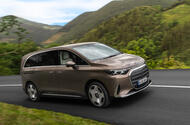
New platform and sharper luxury focus for heir to EQV people carrier
The outgoing Mercedes EQV was an impressive people carrier that brought electric power to a segment long dominated by diesel and offered a credible alternative to the Volkswagen’s ID Buzz. But despite its strengths, it never entirely escaped its origins. it always felt like a well-executed electric version of a van.
The new Mercedes VLE is based on Mercedes’ new Van Electric Architecture (VAN.EA) that will support not only electric but also petrol and diesel models. It sits at the centre of a new family of electric MPVs that will stretch from the next-gen Vito commercial vehicle to the luxurious Mercedes-Maybach VLS unveiled earlier this year.
The scale of progress over the EQV is immediately evident. The VLE will be offered in standard-wheelbase form measuring 5309mm long with a 3342mm wheelbase, alongside a 5484mm version on a 3517mm wheelbase when UK sales begin later this year.
The range opens with the front-drive VLE 300, powered by a 272bhp front-mounted permanent magnet synchronous motor. Drawing from a 115kWh battery, it is said to cover 414 miles on a charge, and it can hit 62mph in 9.5sec. Above it sits the dual-motor VLE 400 4Matic, with 416bhp. Mercedes claims 0-62mph in 6.5sec and a range of “more than” 391 miles. Both receive the same 115kWh nickel-manganese-cobalt battery and 800V architecture, and DC charging is rated at 300kW.
Mercedes plans to broaden the line-up next year with two additional models using a 80kWh lithium-iron-phosphate battery.
The VLE seats between four and eight, depending on configuration, and offers a wide variety of layouts. A new ‘Roll and Go’ function allows seats to manually slide, fold and be removed, while electrically adjustable versions can be repositioned remotely via the infotainment or an app.
Material quality is markedly improved, with richer materials and a more contemporary feel than in the EQV. An optional MBUX Superscreen spans the dash, while a panoramic roof, ambient lighting and an optional 31.3in retractable rear display bring the cabin in line with Mercedes’ passenger cars.
Behind the wheel, the driving position is noticeably more car-like than before. This is attributed largely to a lower seating position and a reduced steering wheel angle that matches the GLE and GLS. The result is far less of the upright, van-like feel that characterised the EQV.
Visibility remains generally good, although the thicker A-pillars needed to satisfy US crash regulations can obscure the view at tight junctions. But once on the open road, a large glasshouse and mirrors plus a full sensor system provide excellent awareness of the VLE’s surroundings.
Rear-wheel steering gives the VLE outstanding manoeuvrability. Mercedes claims a turning circle of 10.9m, comparable to that of a CLA, and the effect is immediately apparent in city driving.
Refinement is a leap forward, too. Despite its size, wind noise is exceptionally well suppressed and road noise remains subdued. Mercedes credits a stiffer structure, extensive sound insulation and a decoupled drivetrain. Whatever the reason, the VLE has a composure that is much closer to the company’s passenger car range than any previous van-based MPV.
Optional Airmatic suspension reinforces that impression, with an excellent ride and disciplined body control, and there is little of the float often associated with large MPVs. On the downside, the brake pedal has a somewhat vague bite point, but its regen system, adjustable via steering wheel paddles, ranges from near coasting to one-pedal driving in town.
Performance is entirely fit for purpose. The single-motor, front-drive VLE 300 delivers strong low-speed response and effortless overtaking performance, although hard acceleration can occasionally provoke a trace of torque steer. The dual-motor, four-wheel-drive VLE 400 4Matic is more resolved, deploying its power cleanly and providing excellent traction.
What stays with you is the sense of effortlessness. The VLE shrinks around you in town, cruises with impressive refinement and combines comfort with genuine practicality and versatility.
The forthcoming Maybach VLS may ultimately become the headline act in Mercedes-Benz's new electric van family when it is launched in the UK next year. But it is the VLE that will carry the weight of the company's ambitions. Bolder in appearance, more spacious and significantly more refined than the EQV, it broadens the appeal of the large, van-based MPV considerably.
Mercedes-Benz VLE 300Refined and sophisticated, with outstanding manoeuvrability, long-distance comfort, efficiency and versatility
Price £75,000 (est) Engine Permanent magnet synchronous motor Power 272bhp Torque 279lb ft Gearbox 1-spd reduction gear, FWD Kerb weight 3500kg 0-62mph 9.5sec Top speed 112mph Battery 115kWh (usable) Range, economy 414 miles, 3.1mpkWh CO2, tax band 0g/km, 4% Rivals VW ID Buzz LWB, Peugeot E-Traveller, Ford E-Tourneo Custom, Kia PV5 Traveller
Popular Products
No popular products available in this category.