How Long Is This Sustainable?
“Corporate profits as a share of national income have increased. . . so have customer complaints.”
That’s from recent commentary by Claes Fornell is the Donald C. Cook Distinguished Professor of Business Administration (Emeritus) at the Ross School of Business, University of Michigan from the American Customer Satisfaction Index (ACSI).
Wall Street isn’t, as is often pointed out, Main Street, nor is it driveways across the land.
The observation, while encompassing a large swath of corporations of all types, does likely encompass how companies like GM and Ford are doing. In Q3 both companies were profitable. Perhaps not as profitable was they were a year ago, but still in the black.
And certainly in the case of Ford, which is running up its number of recalls to record levels, while they may not be “customer complaints,” per se, let’s face it: those who get a recall notice aren’t necessarily happy. (Some management consultants make the argument that if companies take care of customers in an over-and-above manner they can engender better customer loyalty, which may work once or twice, but there are limits.)
Customer Choice?
Fornell points out something else occurring in the market that is described as a “mostly unnoticed threat to the very functioning of the U.S. economy,” which stems from the profits being generated in the context of weakening customer satisfaction.
Or, as ASCI puts it, “the decoupling of buyer utility from seller profit.”
While it could be argued that automotive consumers have a tremendous choice of vehicles, that level of tremendousness has been declining over the past few years as some automakers—with GM and Ford being good examples—have reduced the number of vehicles available at low price points while increasing those that provide them with the maximum margins.
Which goes to the ACSI point: “Overall, markets have become more concentrated with rising seller pricing power.”
In other words: If you want to buy a new vehicle from Ford or GM, then chances are you’re going to find something in a dealership that is going to set you back quite a bit because what you’re likely to find are large SUVs and pickups, often with trim packages that reference precious metals. Or you’re going to find a crossover of some type that is more costly than, well, a car.
Yes, even smaller crossovers, as we’ll see in a moment, are more expensive.
Big Numbers
According to Edmunds, in Q3 2025 19.1% of new vehicle buyers signed up for loans with a monthly payment of $1,000 or more.
In addition to which, 22% of those financing a new vehicle purchase had loans of 84 months or longer. To save you from doing the math: 84 months = 7 years.
According to the U.S. Census Bureau, the Q3 2025 median household income in the U.S. is $84,000. So for someone buying a new vehicle and paying $1,000 a month, this means 14% of their gross income is going to pay for those wheels.
Given that the median household income is calculated before taxes, the percentage of the take-home pay is even greater.
People Want Cars
According to Kelley Blue Book, the average transaction price (ATP) for a compact car in October was $26,982. The ATP for a subcompact car was $25,838.
If you go to your local GM dealer, unless you go to one with a Cadillac logo, you’re not going to find a car—and even though Cadillac still sells cars, the ATP at Cadillac in October was $84,579, more than that median household income.
Well, there are cars at Chevy: the Malibu that is no longer produced could be found, perhaps if you’re lucky (there were 998 sold in Q3). And there is the Corvette, but. . . .
Similarly, over at Ford the “car” is the Mustang. Period.
“But nobody likes cars anymore. They want crossovers,” the common wisdom has it.
But let’s look.
Through Q3 Toyota sold 179,983 Corollas and 234,426 Camrys.
Honda sold 188,225 Civics and 109,677 Accords.
Hyundai sold 116,212 Elantras and 45,914 Sonatas.
Kia sold 107,643 K4s and 52,581 K5s.
To put those car sales into some context:
Buick, which now sells only crossovers, had total sales through the third quarter of 156,835 vehicles.
(Buick is in a particularly tricky state given that of the four vehicles it offers, two are from South Korea, one from China and the remaining one from the U.S.)
Lincoln, again, another brand with just crossovers, had total Q3 sales of 78,823 vehicles.
(Certainly a Navigator has huge margins compared to the cars listed here, but is that sustainable for an entire brand?)
What’s Selling?
Consider this: through Q3 the non-pickup-up GM model with the greatest sales was the Chevy Equinox crossover, 203,583 units. Over at Ford it was the Explorer crossover, at 160,929.
Neither sold as well as the Camry non-crossover. (And it should be pointed out that all Camrys are hybrids, which is becoming an increasingly important powertrain. Which you can’t get in an Equinox or Explorer.)
If we go back to the KBB numbers, in October the ATP for a Compact SUV/Crossover was $36,216; a Subcompact SUV/Crossover, $30,649.
In other words, you could buy a compact car rather than a compact crossover and have $9,000 left over for gas and snacks.
The Limitation of Focus
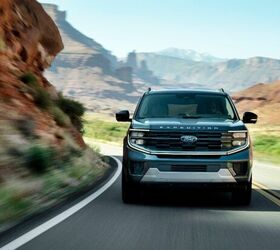
But the focus on crossovers—and particularly big ones—are the financial sweet spots for GM and Ford, Suburbans and Expeditions, as are Silverados and F-150s.
Fornell: “When sellers make profit because buyers have limited choice, the economy suffers. Sellers are supposed to strengthen buyer relationships by providing buyer satisfaction superior to that of their competition. If they do, they would be rewarded. If they don’t, consumer and equity markets render punishment. That is how a market economy is supposed to work, but that is not what we have today.”
Instead, we have a situation where there are limited offerings and companies still reap rewards.
For now.
At some point—and this may be sooner rather than later—the affordability crisis is going to catch up with consumers. That huge monthly car payment is going to become untenable.
And one way this will be manifest is back where we started: customer complaints because they’re going to find that there are slim pickings—if any—at their local Ford or GM dealerships.
And at some point this may have a consequence on their earnings.
When there is that $9,000 difference between a crossover and a car, recognize that’s some 10% of a median household income—not a small amount.
Long-time automotive journalist Gary Vasilash is co-host of "Autoline After Hours" and is a North American Car, Truck & Utility of the Year juror. He is also a contributor to Wards Auto and a juror for its 10 Best Interiors UX and 10 Best Engines & Propulsion Systems awards. He has written for a number of outlets, ranging from Composites Technology to Car and Driver.
The TTAC Creators Series tells stories and amplifies creators from all corners of the car world, including culture, dealerships, collections, modified builds and more.
Check out Gary's Substack here.
[Image: ]
Become a TTAC insider. Get the latest news, features, TTAC takes, and everything else that gets to the truth about cars first by subscribing to our newsletter.
Popular Products
No popular products available in this category.